
Independently Load Tested
Third-Party Engineering Verification: What Our Covers Are Tested For
We paid a licensed structural engineer to load test our covers. Here is what he found, and what he did not.

Nobody Is Required To Test A Window Well Cover. We Did It Anyway.
Window well covers are not required by most building codes. There is no ASTM test method for them. There is no standard a manufacturer has to meet, and no number a buyer can compare.
That is not our opinion. It is the opening of the engineering report we commissioned.
So in February 2026 we hired 808 Structural LLC in Colorado Springs and asked them to test our covers against the residential live load requirements in the 2024 International Building Code. Not the easy version. Our two worst-case configurations, on the largest window well most Colorado homes have.
Tyler C. Allen, P.E., signed and sealed the results. Colorado Professional Engineer License #60982. You can read all 16 pages below.
Certified to the Residential Code Load Standard
Our covers are certified for the standard residential loads in the 2024 International Building Code, the 2024 International Residential Code, and ASCE 7-2022: a 40 pound per square foot uniform live load and a 250 lb point load, both sustained without permanent damage. The 250 lb figure is the engineer's stand-in for the typical weight of an adult.
To be precise about what that means: no code body certified anything. No code requires a window well cover at all. What we did was take the load standard the code sets for a residential floor and have an engineer test our covers against it.
The certification applies to window wells up to 6'-0" span at widths up to 3'-6", up to 6'-8" span at widths up to 3'-0", and half-circle wells up to a 3'-4" radius. Larger openings need a custom design, and we will tell you at measurement.
He Put the Weight Where It Would Do the Most Damage
Certification is the floor. The testing went past it, and the setup was deliberately unkind.
The point load was placed at the weakest location on the cover, along the side edge, where the weight is carried mostly by the polycarbonate rather than the aluminum. That is the opposite of how you would test something you wanted to pass.
Both specimens held 800 lb of uniform load, equal to 45 psf, and a 260 lb point load for a full minute. No slip off the well walls. No yielding. No permanent deflection. No damage of any kind.
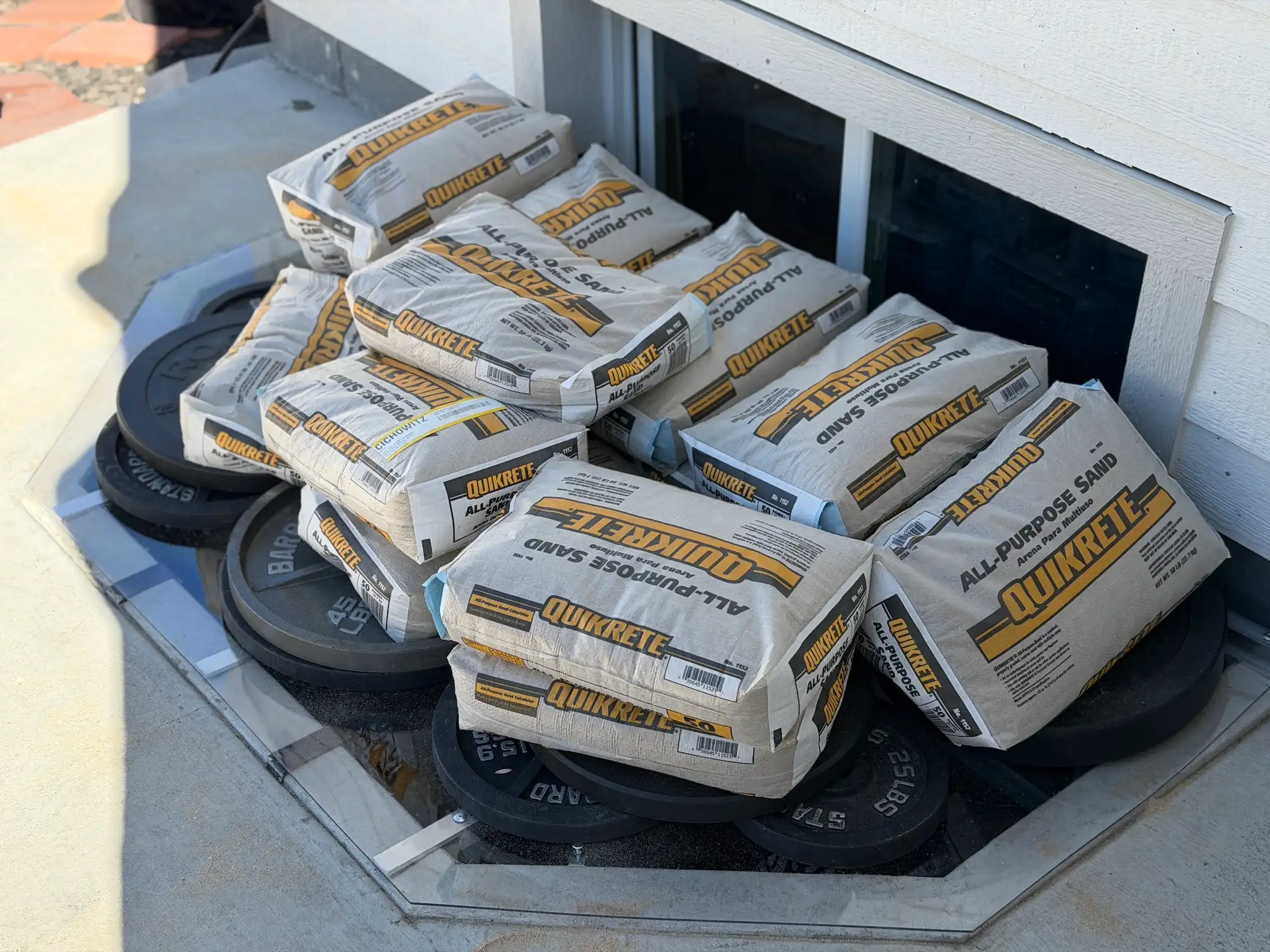
Certification is the floor. The testing went past it, and the setup was deliberately unkind.
The point load was placed at the weakest location on the cover, along the side edge, where the weight is carried mostly by the polycarbonate rather than the aluminum. That is the opposite of how you would test something you wanted to pass.
Both specimens held 800 lb of uniform load, equal to 45 psf, and a 260 lb point load for a full minute. No slip off the well walls. No yielding. No permanent deflection. No damage of any kind.
| Test | Code minimum | Sustained, both specimens | Failure load, Specimen 1 |
|---|---|---|---|
| Uniform live load | 40 psf (704 lb) | 45 psf (800 lb) | 71 psf (1,250 lb) |
| Point load | 250 lb | 260 lb | 400 lb |
| Damage at certified load | None permitted | None observed | Failure test only |
Test results, not ratings. The certified figures are 40 psf uniform live load and 250 lb point load, for window wells to 6'-0" span.
What Was Actually Tested
The engineer asked for our two worst-case configurations. Here is exactly what he got.
| Component | Specification |
|---|---|
| Frame | Type 6061-T6 extruded aluminum |
| Stays | Aluminum angle, 1¼" by 1¼", 3/16" thick |
| Back member | Custom 1½" deep aluminum Z section |
| Panel | 0.15" UV-stabilized polycarbonate, riveted to the frame |
| Bearing | Polycarbonate overlaps the inner edge of the well by at least 1.25" |
| Spans over 6'-0" | Four stays, spaced no more than 1'-6" apart |
That is the whole build. Nothing proprietary is hidden behind a marketing word, because the spec is the argument.
You can see our custom polycarbonate covers and how each one is built to the measurements of your well.
Which Window Wells Are Covered by the Certification
| Well shape | Certified limit |
|---|---|
| Rectangular | Maximum span 6'-0", widths up to 3'-6" |
| Rectangular | Maximum span 6'-8", widths up to 3'-0" |
| Half-circle | Maximum radius 3'-4" |
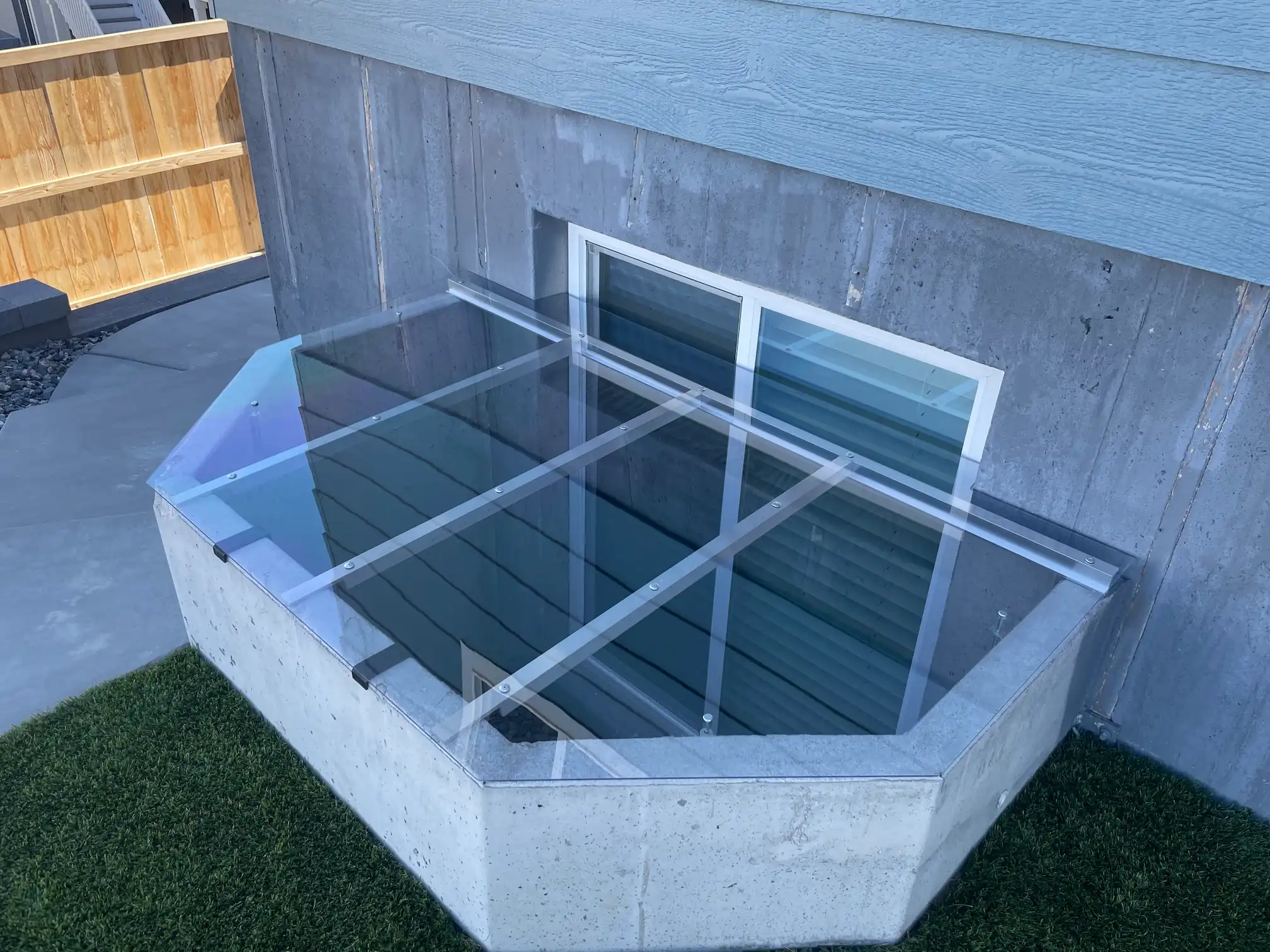
| The tested well | Half-octagon, 5'-8" wide by 3'-5" deep, 17.6 square feet |
| Spans over 6'-0" | Four aluminum stays, spaced no more than 1'-6" on center |
Book a measurement and we will tell you which side of the line your well falls on.
Sizing also sets the price. What a custom cover costs is published, starting at $425.
The engineer chose a well from a home built in the last five years, because modern code has pushed egress wells larger. In his words it "represents the higher end size of most window wells encountered," and wells bigger than it "are uncommon."
That matters for you in a good way. If your well is smaller than the tested one, the same design is approved for the same loads, and smaller spans can use fewer stays as long as they stay within 1'-6" spacing. Most Colorado window wells sit inside the certification, not outside it.
Wells larger than the tested well need their own design and their own analysis.
Book a measurement and we will tell you which side of the line your well falls on.
Concrete, Metal, Fiberglass, Masonry, or Wood
The testing was done on concrete well walls, deliberately, so the walls themselves would not flex and skew the results.
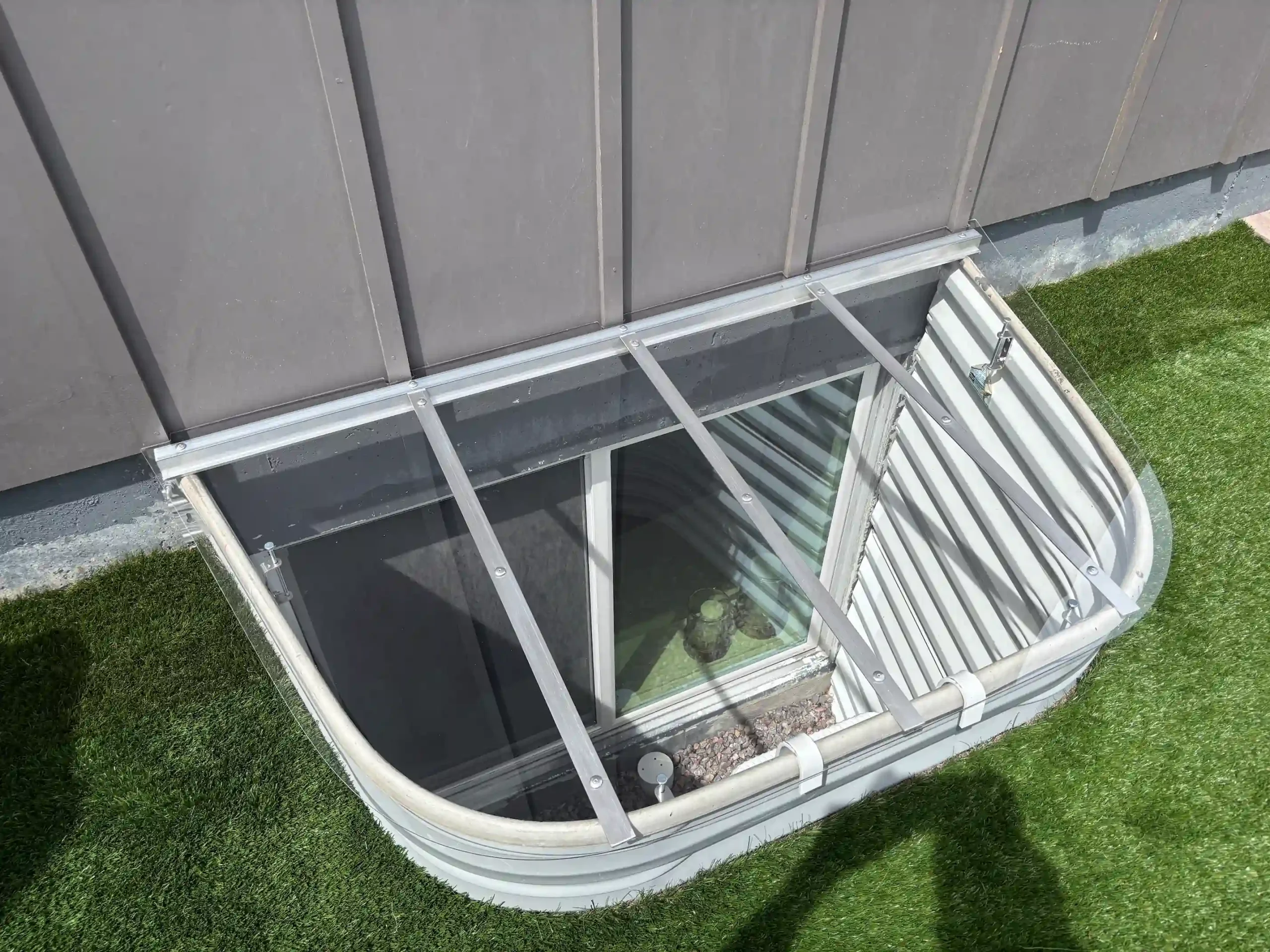
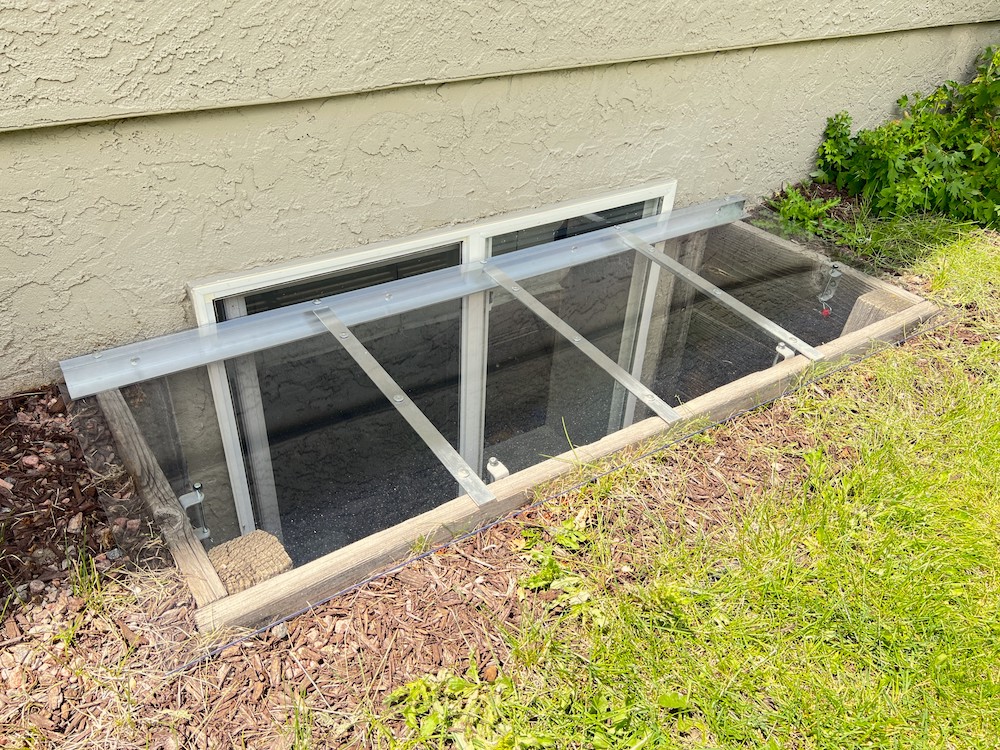
The engineer's finding: the results hold for corrugated metal, fiberglass, masonry, and wooden wells too, as long as the well is in good condition and well maintained.
If your well is crumbling or rotted, that is a different conversation, and we will have it with you honestly at measurement.
One more thing the testing settled: the engineer found the load on the concrete well walls to be "orders of magnitude lower than the capacity of the walls." A cover like this does not put your window well at risk.
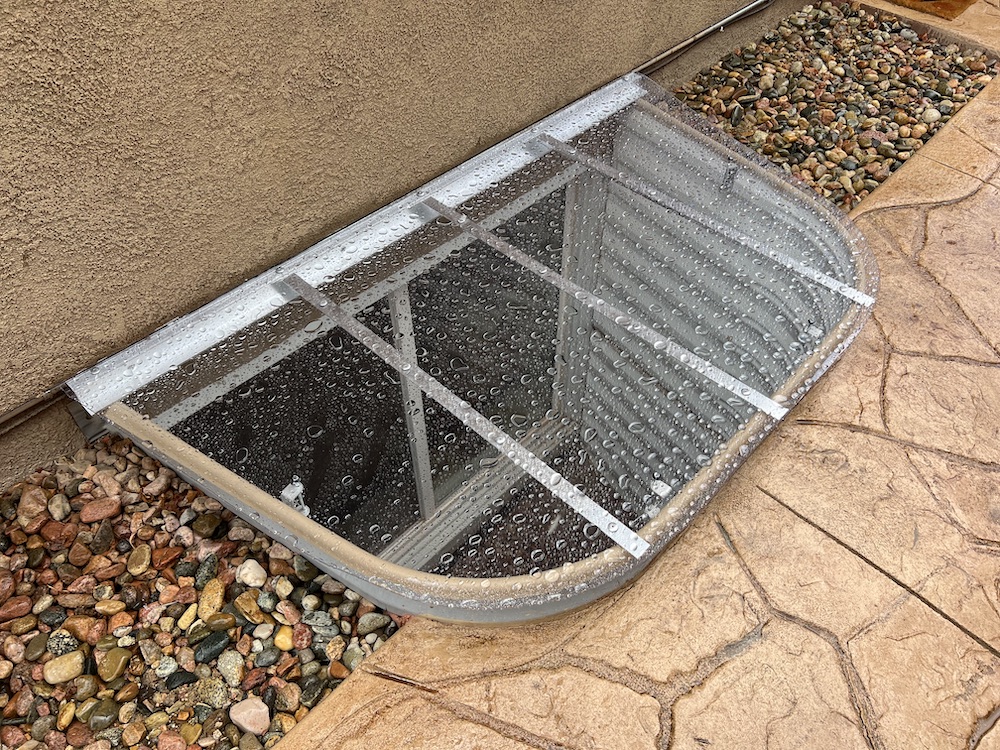
The Engineer's Conclusion, In Full
"The window well covers provided by Windows Well Covered – Custom Window Well Covers as part of this test are, in our professional opinion, a properly designed and engineered solution that not only provides a translucent cover for your window wells, but also are capable of withstanding greater than the building code required static live loads and point loads keeping both children and adults safe when incidental loading events occur."
Tyler C. Allen, P.E.
808 Structural LLC, Colorado Springs, CO
Colorado Professional Engineer License #60982
February 25 2026
What the Report Does Not Say
The testing measured structural performance under static loads. It does not certify our covers as walking or standing surfaces, and we do not sell them that way.
In the engineer's words: "The window well testing performed should not be interpreted that window well covers are intended to be walking surfaces or play surfaces for children or adults."
There is a good reason for that, and it is not weakness. An egress cover has to come off fast. The report puts it plainly: covers "are required to be unobstructed to ensure ease of removal in the event an emergency requires a person to egress via a window well to evacuate a home." A cover built to be stood on is a cover built to be heavy, and a heavy cover is the wrong thing to have over a basement bedroom window.
What the covers are engineered for is incidental loading: a child briefly stepping on one, a pet running across, an adult falling in from ground level. The engineer addressed that directly too: "Incidental dynamic loading from children (weighing less than 50 lb) jumping on window well covers or adults falling from ground level is highly unlikely to cause failure of the window well cover."
Please read our full warranty and product warnings before you buy.
Want to know if your well is covered?
Send us your measurements and we will tell you which configuration fits, or come out and measure for you. No obligation either way.
Or call 719-445-2025 in Colorado Springs, 720-805-1711 in Denver.
Frequently asked questions
Do not use
Are window well covers required by building code in Colorado?
No. Most building codes do not require a window well cover, and there is no ASTM test method for them. That is exactly why we had ours independently tested. Without a standard, there is no number for a buyer to compare, so we created one a licensed engineer will put his seal on.
What load are your covers certified for?
A 40 pound per square foot uniform live load and a 250 lb point load, matching the residential requirements in the 2024 International Building Code, the 2024 International Residential Code, and ASCE 7-2022. Both were sustained without permanent damage. The certification applies to window wells up to 6'-0" span at widths up to 3'-6", up to 6'-8" span at widths up to 3'-0", and half-circle wells up to a 3'-4" radius. In layman terms, that is 800lbs on the largest tested cover!
Can I walk or stand on the cover?
No, and we do not sell them that way. The engineer was explicit that the testing should not be read as making these walking or play surfaces. An egress cover has to lift off quickly in an emergency, which means it cannot be built heavy enough to stand on. What the covers are engineered for is incidental loading, such as a child briefly stepping on one or an adult falling in from ground level.
Will the certification apply to my window well?
Most likely. The engineer deliberately tested a well from a recently built home, which he described as representing the higher end of the sizes normally encountered, and noted that larger wells are uncommon. If your well is smaller than the tested one, the same design is approved for the same loads. Wells larger than the tested well need their own design, and we will tell you at measurement.
Does it work on a metal or fiberglass window well?
Yes. The testing was done on concrete walls so the walls themselves would not flex and skew the results, and the engineer found the results hold for corrugated metal, fiberglass, masonry, and wooden wells too, provided the well is in good condition and well maintained.
Who did the testing?
808 Structural LLC of Colorado Springs. The report was signed and sealed by Tyler C. Allen, P.E., Colorado Professional Engineer License #60982, on 25 February 2026. The full 16-page report is available to download above. It’s worth noting he is also a satisfied customer, proud to have our window well covers on his own house.